
A buyer wrote last month with a P1.5 wall, a 6 m room and three quotes that differed by 40%. One was SMD, one was GOB, one was COB. The spec sheets looked identical — same pitch, same 600 nits, same 3,840 Hz. The difference was in how the light gets out of the package, and that is the only difference that survives two years on a wall.
What is physically different
SMD is a lamp: a plastic or ceramic bracket with an LED die inside, soldered onto the board, with a metal reflector cup around it. The bracket is the thing you see, and the gap between brackets is the black you get.
GOB is SMD with the whole board face flooded in a clear or diffused resin. The brackets are still there, buried. The resin protects them and flattens the surface.
COB has no bracket. The die is bonded directly to the board and a thin layer of encapsulant sits over it. There is no cup, no wire bond standing up in the air, and no gap between components — just board, die and laminate.
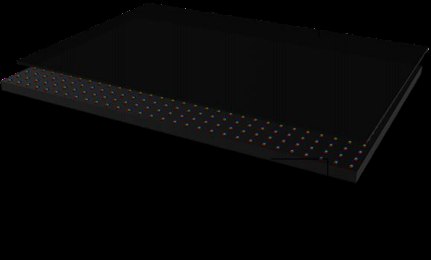
That single mechanical fact drives everything else on this page.
What it does to the black
On an SMD wall the black you see between pixels is the board showing through the gaps between brackets. The inside of the cup is usually light grey or white, which is what makes an SMD wall look like a grid of dots from an angle. Contrast lands somewhere around 3,000:1 to 5,000:1 on a typical indoor module.
On COB the surface between emitters is dark laminate and the emitter covers less of it. Standard COB cabinets measure 10,000:1. The virtual-pixel variant pushes the same idea harder — smaller chip, twice the black area — and reaches about 30,000:1.
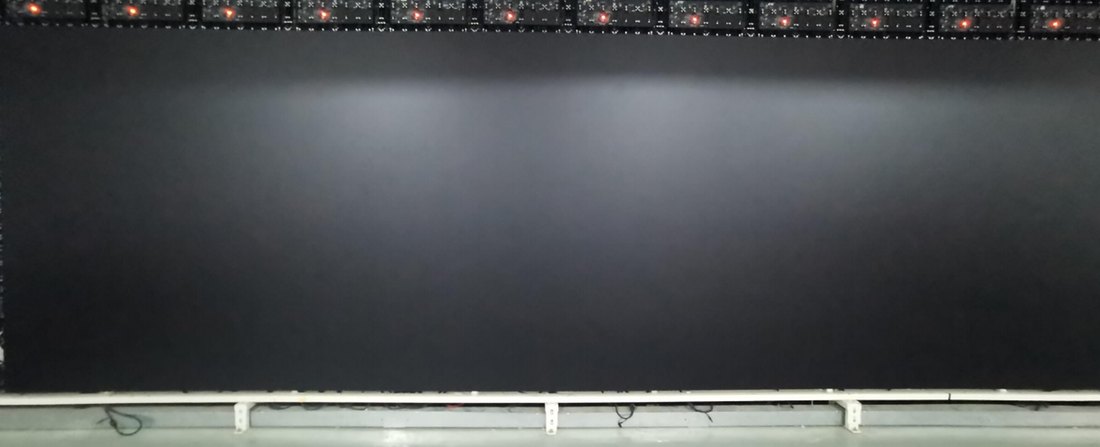
This is why COB gets specified for control rooms and home cinema and rarely for a shopping mall atrium. In a bright room, contrast is limited by ambient light reflecting off the surface, not by the panel. You pay for black you cannot see.
Where COB loses
Three places, and they are real.
Brightness. A mainstream COB cabinet is a 600-nit product. The S-series reaches 1,000 nits and that is the top of the range. SMD goes higher for less money, which is why outdoor and high-ambient work is still SMD.
Field repair. A dead SMD pixel can sometimes be replaced with a soldering iron and a spare lamp. A dead COB die cannot — the module goes back. In practice both end up as a module swap, but the SMD option exists and buyers ask for it.
Price at coarse pitch. At P2.5 and above SMD is simply cheaper per square metre, and at a 6 m viewing distance the visual difference does not justify the gap.
Where GOB fits
GOB is not a cheap COB. It is a protected SMD, and it solves a different problem: physical abuse. A GOB wall survives a football, a cleaning crew with a mop, and a rental crew stacking panels face to face. The optical performance stays close to SMD — same brackets, same gaps — so the black level does not improve much.
If the requirement is that the screen must not be damaged, GOB. If the requirement is that the screen must look like a dark sheet of glass, COB. Different briefs, and buyers confuse them constantly.
The decision, in numbers
Room under 500 lux, viewing distance under 4 m, screen people will touch: COB. The matte laminate takes a fingerprint wipe, surface hardness is 4H, the front face is IP54, and it cleans with water rather than a specialist solvent.
Room with daylight or track lighting: SMD at 1,000+ nits, or the COB S-series if the client insists on the surface. Do not put a 600-nit panel in a glass lobby and then blame the panel.
Rental, stage, anywhere the panel gets handled: GOB or a rental SMD in a proper flight case. COB is not a road product.
Pitch coarser than P2.0 with a viewing distance over 5 m: SMD. The package stops mattering and the budget belongs in the control system instead.
One thing buyers get wrong
They compare COB and SMD at the same pitch and expect COB to look sharper. It does not. Same pitch means the same number of pixels. COB looks smoother — no visible bracket, no specular highlights, a more even black — and that reads as sharper at a distance, but the resolution is identical.
If you need more resolution, buy a finer pitch. If you need the wall to stop looking like a grid of lamps, buy COB. Two different purchases.